
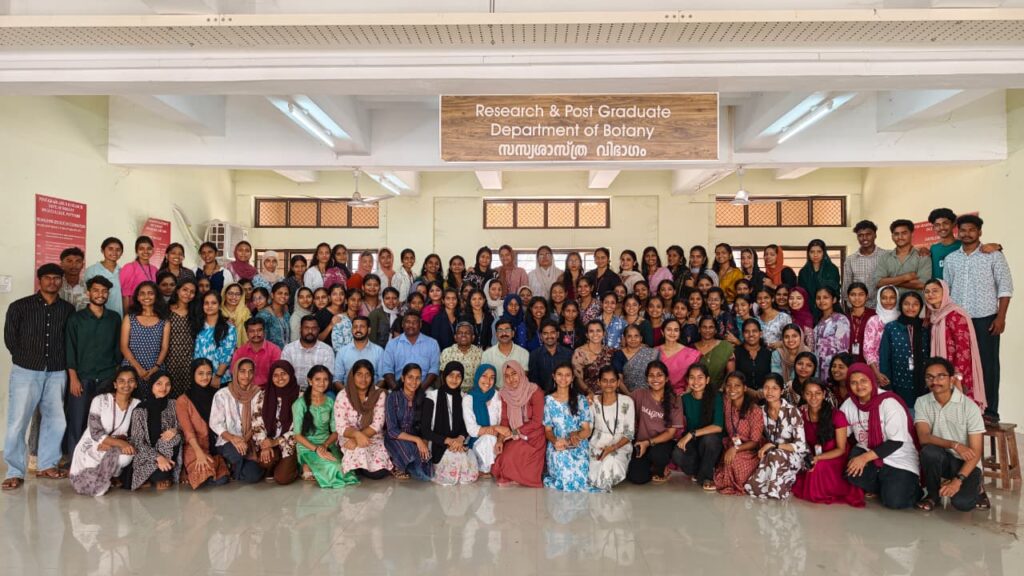
The Post-Graduate and Research Department of Botany, established in 1957 with the introduction of science courses at the then Pre-Degree level, has evolved into a vibrant centre for Plant Science education, research, and community engagement. The department commenced its Under-Graduate Programme (B.Sc. Botany) in 1979, followed by the Post-Graduate Programme (M.Sc. Botany) in 1995. In response to its growing academic maturity and research orientation, doctoral research programmes were initiated in 2015. From 2024 onwards, the undergraduate programme has been restructured as a Four-Year Undergraduate Programme (B.Sc. Botany Honours), aligning with national educational reforms and contemporary academic standards.
The department is guided by a clear academic philosophy that integrates classical botanical knowledge with emerging areas of modern plant sciences, emphasizing ecological sustainability, scientific integrity, and research-embedded learning. Its academic and research activities are focused on interdisciplinary and application-oriented domains such as plant–microbial interactions, stress physiology, biodiversity conservation, medicinal plants, and plant biotechnology, with particular relevance to regional and global environmental challenges.
The Department is supported by a team of seven dedicated faculty members and four non-teaching staff. Of the faculty members six hold doctoral degrees, and two are Recognized Research Guides of the University of Calicut. With a strong research culture and sustained scholarly output, the Department has been recognized as a Research Centre under the University of Calicut, reflecting its consistent progress in research excellence and academic leadership.
Teaching and learning in the department are student-centered, outcome-oriented, and experiential, with strong emphasis on laboratory training, field-based learning, undergraduate research exposure, and the development of analytical and critical thinking skills. Students are actively encouraged to participate in research projects, seminars, workshops, and extension activities, enabling them to pursue higher education, research careers, and diverse professional pathways.
The department also maintains a strong commitment to social responsibility and environmental stewardship through outreach programmes, workshops and trainings, biodiversity conservation initiatives, and community engagement activities. Over the years, it has nurtured a dynamic alumni network whose members have distinguished themselves in academia, medicine, scientific research, social service, and other professional sectors, significantly enhancing the reputation and visibility of the institution. With a forward-looking vision, the department continues to strengthen its academic programmes, expand its research collaborations, and contribute meaningfully to sustainable development and the advancement of plant sciences at regional, national, and global levels.
Vision
To emerge as a centre of excellence in plant science education and research, fostering scientific inquiry, ecological responsibility, and innovation to address contemporary environmental and societal challenges.
Mission
- To impart quality, outcome-oriented education in botany through innovative and research-integrated teaching–learning practices.
- To promote interdisciplinary and application-oriented research addressing biodiversity conservation, environmental sustainability, and plant-based solutions.
- To nurture scientific temper, ethical values, and critical thinking among students, preparing them for higher education, research, and professional careers.
- To engage with society through extension, outreach, and environmental awareness programmes for sustainable development.
- To strengthen academic collaborations, alumni engagement, and institutional growth at regional, national, and global levels.
Courses Offered
- B.Sc. Botany (Honours) – FYUGP
- BSc Botany
- M.Sc. Botany with Specialization in Genetic Engineering & Tissue Culture
- Ph.D. Programme in Botany
UGC-SWAYAM MOOC
- Fundamentals of Bioinformatics through UGC-SWAYAM platform
Add-on/Value-added Course Offered
- FYUGP Internship Programme in Basic Microbiology Techniques
- FYUGP Internship Programme in Basic Biotechnology & Bioinformatics
- Molecular Biology/Biotechnology Training for UG/PG/PhD/School Teachers/College Teachers
- CSIR/UGC NET coaching in Life Sciences
- JAM coaching in Biotechnology
Teaching Learning Practices
- Student-centered and outcome-based education
- Field work, laboratory training, ICT-enabled teaching
- FLIPPED Learning & Reflective Teaching
Research Highlights / Thrust Areas
The department actively engages in interdisciplinary and application-oriented research in the following thrust areas:
- Plant–Microbial Interactions, with emphasis on ecological and functional relationships
- Abiotic/Biotic stress tolerance mechanisms in plants specifically focusing at the molecular level
- Eco-physiological aspects of heavy metal contamination and plant stress responses
- Plant Embryology and Developmental Biology
- Plant Tissue Culture and Conservation of Medicinal Plants
Major Research Projects
- Collaborative Research Project with the Ministry of AYUSH, Government of India (CCRAS-NARIP-SNGS Collaborative Project)
Title: In vitro Propagation and genetic stability studies of Ipomoea mauritianaJacq.- A Rare Medicinal Plant
Project Cost:28,21,800
Principal Investigator:Dr. Vivek P. J.
- DST-SERB SURE Major Research Project
Title: Understanding the mechanism of heavy metal detoxification in Alternanthera tenella Colla. to elucidate its phytoremediation potential
Funding Agency: DST-SERB
Amount sanctioned:29,99,830
Principal Investigator:Dr. Resmi M. S.
- Mini Research Project under Enhancement of Academic Programme for higher Secondary School Teachers
Title: Transcriptomic Analysis for the identification of genes involved in secondary metabolite production in Curculigo orchioidesGaertn.
Funding Agency: Directorate of General Education
Amount sanctioned: 1,48,540
Infrastructure and Facilities
The department is supported by well-developed laboratories and modern research infrastructure that facilitate effective teaching, training, and advanced research:
- Molecular Biology/Microbiology Research Laboratory
- Biotechnology/Tissue Culture Research Laboratory
- Plant Physiology/Biochemistry Research Laboratory
- Bioinformatics Facility
- MSc Practical Laboratory
- BSc Core/Major Practical Laboratory
- BSc Complementary/Minor Practical Laboratory
- Mushroom Cultivation and Extension Activity Centre
- Museum and Herbarium
- Department Library with approximately 1000 referenced books
- Reading Room
- Interactive Class Room
- Green initiatives including Nature Appreciation Centre (Kuttivanam), Biodiversity Park, Botanical Garden, Protected Garden & Butterfly Garden
Major Equipment and Research Resources
The department is equipped with advanced scientific instrumentation and essential laboratory resources, including:
- Real-Time PCR System
- PCR Machines
- Spectrophotometer
- NanoDrop
- Gel Documentation System
- Facilities for isolation and culture of microorganisms
- Biosafety Cabinets
- Refrigerated Centrifuges
- Precision Electronic Weighing Balances
- Other essential laboratory instruments and teaching aids
Student Development and Extension Activities
In addition to academic and research programmes, the Department offers the following services to students, scholars, and the wider academic community:
- Mentoring, Remedial coaching, and career guidance
- Participation in seminars, workshops, internships, and projects
- Extension, outreach, and environmental awareness programmes
- Internship programmes for Undergraduate and Postgraduate students
- Training programmes for research scholars and teachers
- Plant identification and authentication services
- Sharing of laboratory facilities for external students to carry out project work